
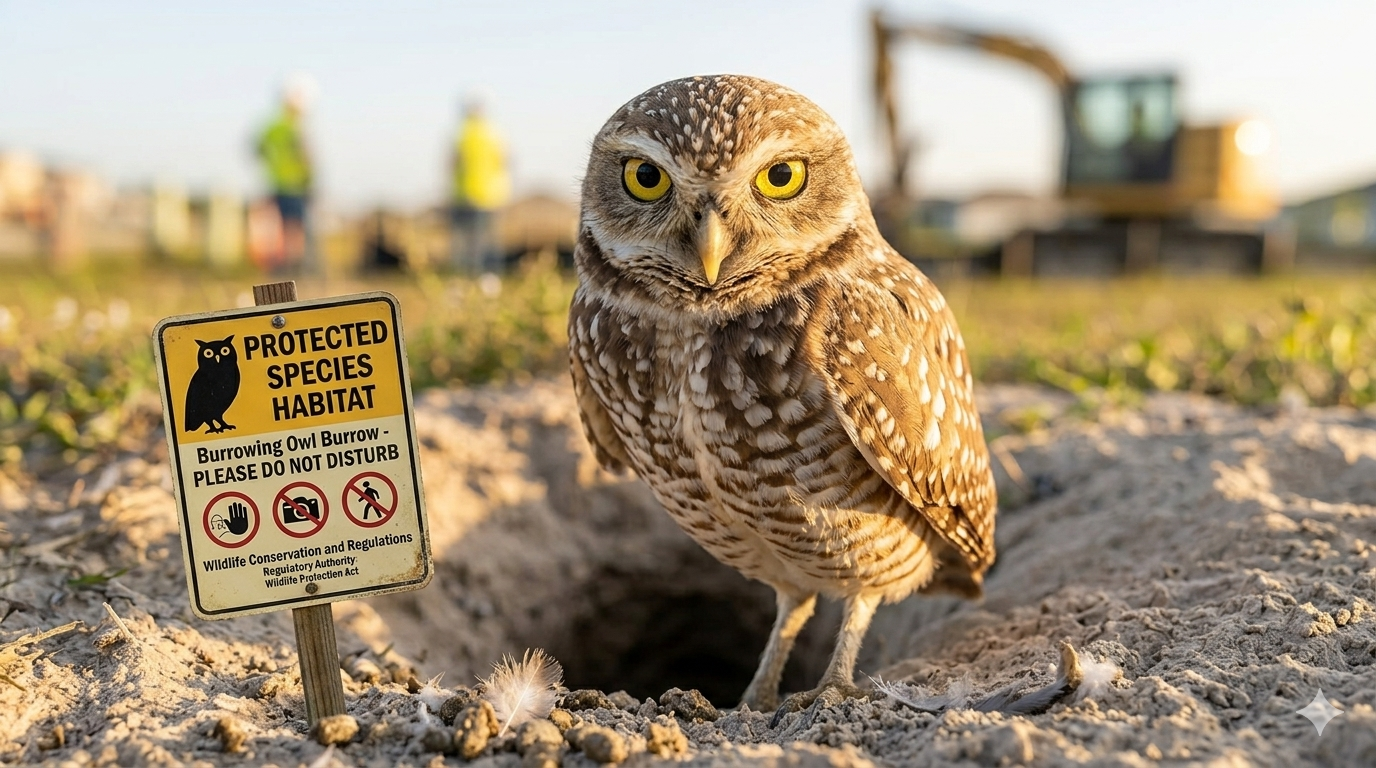
When you live in Florida, spotting wildlife becomes part of your everyday life. But every now and then, you come
across a species that makes you pause and look a little closer. The burrowing owl is one of those birds. Small,
alert, and full of personality, these owls choose the ground instead of the trees, and that alone makes them
fascinating. As you learn more about them, understanding how they live helps you protect them, understand the laws,
and avoid issues when making changes to your property.
These questions become even more important when you learn that burrowing owls are protected here, and your everyday
actions, like mowing, landscaping, or preparing a property for construction, can directly affect their safety.
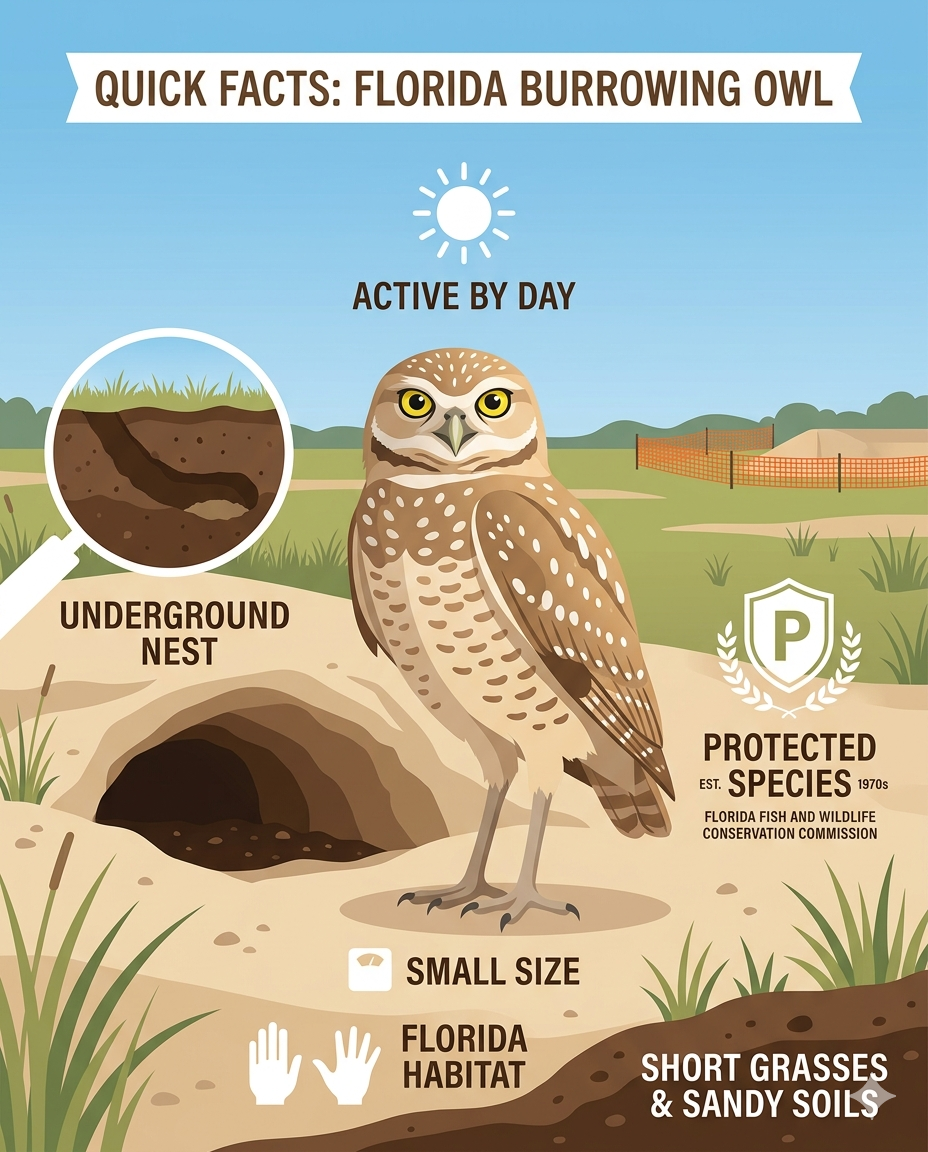
Quick Facts About the Burrowing Owl
A diurnal owl, active during the day.
Scientific name: Athene cunicularia.
Lives in underground burrows, not trees.
Stands 8–10 inches tall with long legs.
Considered a protected species in Florida.
Found in vacant lots, open fields, and construction zones.
Florida’s population stays year-round and does not migrate.
Often seen in groups during the Florida burrowing owl nesting season (spring and summer).
What Is a Burrowing Owl?
A burrowing owl is a small, ground-dwelling owl that lives in underground tunnels instead of trees. Its scientific
name is Athene cunicularia. Unlike many other owls, you can often see a burrowing owl during the day as well as at
dawn and dusk.
You may wonder which states burrowing owls live in. As a ground-dwelling owl, it prefers open areas with short
vegetation. They occur across the western United States, parts of Mexico and Central America, South America, and a
unique, non-migratory population right here in Florida. This makes the Florida burrowing owl especially important
because it stays in the same burrows year-round.
Many people also ask, are burrowing owls rare to see? In some regions, yes. In others, like Cape Coral or Naples, you
might see them often. It depends on how much suitable habitat is available and how much development has occurred in
the area.
How to Identify a Burrowing Owl
You can identify a burrowing owl almost instantly. They are small but confident birds with rounded heads and bright
yellow eyes. They don’t have ear tufts, and their long, thin legs make them look taller than their size suggests.
Here’s what you typically notice:
- Sandy brown feathers with white spots
- Soft facial features
- Bright yellow eyes
- Calm, upright posture
- Long legs that raise them above the grass
Burrowing owls have very expressive behavior. When curious or alert, they often bob their heads. They may stand
outside their burrow for long periods or fly low across open ground to catch insects. Their movements are quick,
simple, and easy to observe.
Habitat and Burrowing Behavior in Florida
You might ask why it’s called a burrowing owl. The name comes directly from their habit of living inside burrows that
they dig into sandy soil. Florida’s terrain makes this easier because it allows them to excavate tunnels without
needing abandoned dens from other animals.
A burrow usually includes:
- A round entrance about 4 – 6 inches wide
- A small mound of loose sand around the opening
- Feathers, pellets, or prey remains nearby
- A tunnel that may extend several feet underground
This type of habitat is important because these owls rely on open visibility. They choose areas like:
- Vacant residential lots
- Parks and school grounds
- Sports fields
- Pastures and farms
- Edges of construction sites
- Wide, open yards
Understanding how they choose these areas helps you know what to do if you find a burrowing owl near your home or
project site.
Where Burrowing Owls Are Found in Florida
Burrowing owls live in several regions across the state, especially in open areas with short vegetation and sandy
soil. You’re most likely to see them in Cape Coral, which has the largest population in Florida and thousands of
documented burrows across vacant lots, fields, and even residential yards. They are also found in Naples, Miami-Dade
County (especially West Kendall), the Tampa Bay region, Sarasota County, areas around Orlando, and rural parts of
Polk County.
In South Florida, several Broward County parks actively protect burrowing owl habitat. You may see marked burrows at
Brian Piccolo Park, Central Broward Park, Markham Park, Plantation Heritage Park, and Vista View Park.
Other locations with notable populations include Marco Island, Pembroke Pines, Port Charlotte, and areas west of
Gainesville. Occasionally, isolated pairs appear farther west, even near Eglin Air Force Base in the Panhandle.
These regions share the same conditions: sunlight, open terrain, and low vegetation. This mix creates the ideal
burrowing owl habitat that Florida is known for.
Diet and Daily Behavior
When you watch a burrowing owl in Florida, you quickly notice how active and alert it is during the day. It is a
diurnal species, but it also hunts during dawn and dusk, which gives you a better chance of seeing its routine
compared to nocturnal owls.
Their diet is flexible and changes with the season. They eat whatever is abundant, which helps them survive in open
environments. A typical Florida burrowing owl diet includes grasshoppers, beetles, crickets, anoles, frogs, small
snakes, rodents, and larger insects. They stay close to their burrows and seldom travel far unless food becomes
scarce. In some areas, they may also eat small birds or even cactus fruit when food is limited.
Burrowing owls use several hunting techniques. You may see them swooping down from low perches like fence posts,
hovering briefly over open ground, or running on their long legs to chase prey along the ground.
They also have interesting defensive behaviors. Juvenile burrowing owls can mimic the rattling sound of a rattlesnake
when threatened inside a burrow. Adults may bob their heads quickly when alarmed, often to judge distance or signal
caution.
Life Cycle and Seasonal Behavior in Florida
Florida’s burrowing owls follow a consistent yearly pattern, and because they are non-migratory,
they stay in their burrows all year long. Understanding this cycle is important, especially if you live or work near
an active nesting site.
Here’s what their yearly cycle looks like:
- Courtship season: Late fall through early spring
- Florida burrowing owl nesting season: Typically March through July
- Egg laying: Usually 6-8 eggs
- Incubation: About one month
- Chick development: Young owls remain in the burrow for several weeks
- Fledging: Around six weeks old
During nesting season, you may see multiple owls around the entrance, adults standing guard, and chicks peeking out.
This is also when they are most sensitive to disturbance, which is why Florida’s regulations emphasize extra care
during these months.
Conservation Status and Threats
According to the Florida Fish & Wildlife Conservation Commission, the Florida burrowing owl is listed as a state-threatened species and
deserves protection because its habitat is rapidly disappearing.
Their biggest threat remains habitat loss. As open land turns into homes, businesses, and new developments, the open
fields, vacant lots, and sandy soils these owls rely on shrink year after year. Some of the most common risks
include:
- Urban development is removing open ground and nesting sites
- Soil disturbance or grading that causes active burrows to collapse
- Mowing or landscaping too close to nest entrances
- Predators such as dogs, cats, and hawks
- Human disturbance around burrows, including vehicles or foot traffic
- Reduction in prey availability when natural habitats are altered
Because burrowing owls often live on the same lands where people build or maintain lawns, accidental disturbance can
easily happen. Per FWC guidelines, disturbing or destroying a burrow or nesting site without proper authorization
may be illegal. That’s why statewide conservation efforts emphasize habitat management, public education, and
careful permitting to balance growth and protection.
Florida Laws Protecting Burrowing Owls
Florida law treats burrowing owls and their burrows as protected. This means you cannot disturb, destroy, block,
fill, or alter any active burrow, even by accident. The law is designed to make sure property improvements,
construction, and maintenance activities do not harm the birds, especially during nesting season.
This includes protection from:
- Direct disturbance
- Burrow destruction
- Equipment damage
- Nest disruption
- Harassment or interference
If you plan development or even simple landscaping, you must understand the burrowing owl regulations Florida
follows. These laws ensure both the species and property owners remain safe. In many cases, you will need a wildlife
survey, a burrowing owl permitting review, or specific construction guidelines to stay compliant.
What Florida Property Owners Should Do If They Find a Burrow
Finding a burrowing owl on your property can feel surprising at first, but it’s more common than you might think.
These owls choose sunny, open lots, and they often nest near homes, yards, or undeveloped land. When you discover a
burrow, the most important thing you can do is avoid disturbing it.
Many people ask what to do if they find a burrowing owl on their land. The answer is simple:
- Step back and keep a respectful distance.
- Do not fill, move, or modify the burrow.
- Avoid mowing too closely.
- Keep heavy equipment away.
- Do not place objects around the burrow entrance.
- Keep pets under control.
- Reduce loud activity in the area.
If you want to know what to do if a burrowing owl is in your yard and you have upcoming property plans, consider
arranging a protected species assessment. This ensures you understand the burrow’s status before you make changes.
Homeowner Checklist: What You Should Do
- Maintain a 10–20 foot buffer around the burrow.
- Do not mow over or near the entrance.
- Avoid digging, trenching, or clearing soil.
- Inform yard workers to stay away from the site.
- Keep pets away from nesting areas.
- Pause any planned improvements until a survey is completed.
- Request guidance if you’re planning construction or major landscaping.
These steps keep you safe, prevent violations, and help protect the owls.
Construction Considerations Near Burrowing Owl Burrows
If you work in development or land clearing in Florida, construction near burrowing owl burrows requires extra care.
These owls, their eggs, and their burrows are protected under state laws, which means you cannot disturb an active
burrow without proper authorization. Before any ground work begins, a pre-construction survey should be completed by
a qualified professional to identify burrows and check activity status.
If burrows are found, you must keep a safe distance. A buffer zone of at least 10 feet is recommended during
non-nesting months, and this distance increases to 33 feet during the nesting season (February 1 to July 31). Inside
these areas, avoid soil grading, digging, heavy machinery use, or storing materials. Keeping vegetation low, around
12 inches or less, helps improve visibility so crews can avoid accidental disturbance.
Some projects may require a burrowing owl permit if planned work could impact a burrow. This may involve monitoring
during construction or following specific guidelines to protect the owls. Planning early helps you stay compliant
with state rules and prevents delays.
Understanding these basic steps ensures you protect wildlife, follow regulations, and move your project forward
responsibly.
Understanding the Burrowing Owl Permitting Process in Florida
If your project may impact an active burrow, you will need a permit. This process is designed to protect the owls
while allowing responsible development to continue. Understanding these steps early helps you plan timelines and
avoid interruptions.
Here’s a simple breakdown of the burrowing owl permitting Florida process:
- Initial site survey to locate and identify burrows.
- Activity assessment to determine whether the burrow is active.
- Documentation and mapping of findings.
- Permit application submission based on project needs.
- Agency review of the application.
- Approval or conditions that outline how work can proceed.
- On-site construction monitoring is required.
- Post-construction monitoring to confirm compliance.
To understand how federal protections apply, you can review guidance from the U.S. Fish & Wildlife Service. This process ensures you follow the burrowing owl regulations Florida requires, while still allowing your project to move forward in a responsible way.
How IVA Environmental Supports Burrowing Owl Projects
When you’re managing land in Florida, especially areas with active wildlife, having the right guidance makes everything easier. IVA Environmental helps you navigate burrowing owl protection clearly and practically.
The team conducts:
- Protected species assessments to determine if owls are present
- Burrowing owl permitting reviews for planned development
- Construction monitoring to keep work compliant
- Habitat Conservation Plan development for long-term planning
- Post-construction monitoring to ensure all requirements are met
The goal is to help you understand what your property needs, what the law requires, and how to move forward while respecting wildlife. The approach is educational and supportive, giving you clarity throughout your project.
Frequently Asked Questions
1. Why are burrowing owls protected in Florida?
Burrowing owls are protected because their habitat is shrinking due to development and land-use changes. State regulations ensure that active burrows, eggs, and chicks are not disturbed, helping the species survive in Florida’s changing landscape.
2. How can you tell if a burrowing owl burrow is active?
An active burrow may show fresh tracks, pellets, prey remains, or newly cleared sand. You may also see owls standing near the entrance at dawn or dusk. Only trained professionals can make an official activity determination.
3. Can mowing or landscaping near a burrowing owl burrow cause problems?
Yes. Mowing too closely can collapse the burrow or disturb nesting owls. Keeping a safe buffer helps prevent damage and avoids violating wildlife protection laws.
4. What triggers the need for a burrowing owl permit in Florida?
You need a permit when construction, clearing, or ground disturbance could impact an active burrow. This includes grading, digging, or using heavy machinery near a nest site.
5. Are burrowing owls dangerous or aggressive toward people or pets?
Burrowing owls are not dangerous and rarely act aggressively. They use vocal warnings or distraction displays instead of physical defense. Pets, however, can harm burrows or chicks, so keep them away.
6. What happens if a burrowing owl chooses to nest on a construction site?
Work must pause until a professional survey is completed. If the burrow is active, you may need monitoring, buffers, or a relocation process during approved times to stay compliant with regulations.
Conclusion
Burrowing owls are one of Florida’s most unique wildlife species, and understanding how they live helps you protect them while managing your property responsibly. When you know the laws, their habitat needs, and the right steps to take, you create a safer environment for the owls and a smoother path for your project. IVA Environmental supports Florida landowners and developers with burrowing owl permitting, wildlife surveys, and compliance guidance.
