
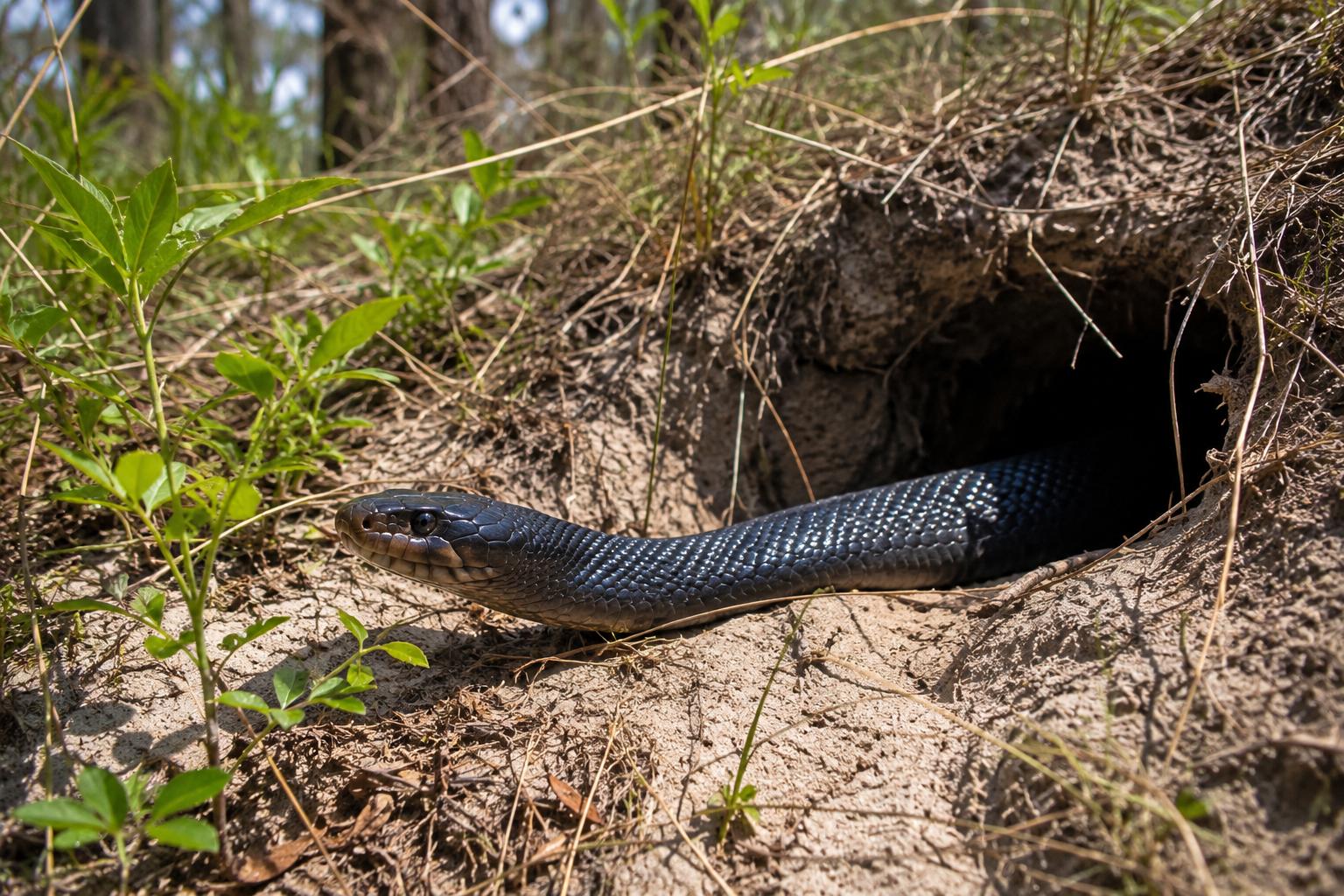
The Eastern indigo snake is the longest native snake in the United States and is federally listed as threatened. Reviewing it on a development site is usually straightforward, but it can get more complicated when the project also involves gopher tortoise burrows, since indigo snakes are known to use those burrows, and burrow work carries its own separate permitting requirements.
If your project involves land clearing, excavation, or development within suitable Eastern indigo snake habitat, an early environmental assessment can help determine whether an Eastern indigo snake survey or additional review may be needed. Identifying potential habitat constraints before land clearing or permit submittal allows developers to better understand regulatory requirements, reduce permitting delays, and maintain compliance with applicable state and federal regulations.
When Is an Eastern Indigo Snake Survey Needed?
An Eastern indigo snake assessment may be required for projects involving:
- Land clearing or development in or near habitat known to support the species
- Excavation, disturbance, or relocation of gopher tortoise burrows, which commonly provide shelter for the species
- Projects located in areas where the U.S. Fish and Wildlife Service (USFWS) or the Florida Fish and Wildlife Conservation Commission (FWC) has identified known or potential Eastern indigo snake habitat
The presence of suitable habitat does not automatically mean Eastern indigo snakes are present on a site. However, where habitat characteristics or gopher tortoise burrows indicate the potential for occupancy, these conditions should be evaluated before land clearing or burrow disturbance takes place.
Early environmental review helps identify potential permitting requirements and supports better project planning before construction activities begin.
Why Eastern Indigo Snake Surveys Require Special Consideration
Eastern indigo snake reviews differ from many routine protected species assessments because they often involve both state and federal regulatory requirements. Developers don’t always realize that disturbing a gopher tortoise burrow can also trigger federal considerations if an Eastern indigo snake is using the burrow for shelter.
The overlap typically involves two regulatory agencies:
Species |
Primary Regulatory Agency |
Key Consideration |
| Gopher Tortoise | Florida Fish and Wildlife Conservation Commission (FWC) | Gopher tortoise burrows require FWC authorization before excavation or relocation. |
| Eastern Indigo Snake | U.S. Fish and Wildlife Service (USFWS) | Eastern indigo snakes frequently use gopher tortoise burrows for shelter. If suitable habitat or potential occupancy exists, USFWS protection measures and additional review may apply. |
Because these two protected species are closely connected, projects involving gopher tortoise burrows often require careful environmental review to determine whether Eastern indigo snake considerations also need to be addressed. Evaluating both requirements early helps reduce permitting challenges, avoid construction delays, and support regulatory compliance.
The Permitting Complexity That Limits Who Can Do This Work
A typical Eastern indigo snake review may include habitat evaluation, visual encounter surveys, documentation of potential refugia, and implementation of USFWS Standard Protection Measures. These activities generally focus on observation and avoidance, not capture or handling. If an Eastern indigo snake is observed, it shouldn’t be handled unless the individual has the appropriate state and/or federal authorization.
Many projects are required to follow USFWS Standard Protection Measures for the Eastern indigo snake, including worker awareness, stop-work procedures if a snake is observed, and restrictions on harming or handling the species. Those measures are important, but they don’t replace any required agency consultation, project-specific review, or authorization.
The issue becomes more complicated when gopher tortoise burrows are present. Eastern indigo snakes are known to use gopher tortoise burrows, and gopher tortoise burrow disturbance or relocation requires FWC authorization. Where a project involves both potential indigo snake habitat and gopher tortoise burrow excavation, the team should include personnel with Eastern indigo snake survey experience and FWC-authorized gopher tortoise relocation capability.
| Compliance note: FWC requires an Authorized Gopher Tortoise Agent for off-site tortoise relocation, and for on-site relocation involving more than 10 burrows. Smaller on-site jobs can, in some cases, be handled by the landowner or a Registered Agent after completing FWC’s required training. Where indigo snake considerations overlap with burrow work of any size, using a properly credentialed team still helps avoid delays and compliance exposure. |
What the Process Typically Involves
1. Habitat and Site Review
Evaluating whether site conditions (vegetation type, burrow presence, proximity to known habitat) suggest indigo snakes could be present.
2. Visual Encounter Survey
A field survey following the applicable protocol to look for direct sightings or sign of the species, focused on observation rather than capture or handling.
3. Standard Protection Measures
Implementing USFWS worker-awareness and stop-work procedures during construction if required for the project.
4. Burrow Coordination
Where gopher tortoise burrows are present and require excavation or relocation, involving FWC-authorized personnel and excavation methods designed to reduce risk to any indigo snake that may be present.
5. Agency Coordination & Reporting
Confirmed sightings are reported to the appropriate agencies, and findings help inform permitting decisions alongside other protected-species results.
Why This Matters for Project Timelines
Because the indigo snake and gopher tortoise pieces are governed by different requirements, it’s not uncommon for a project to reach the burrow-excavation stage before anyone confirms whether the assigned team actually holds gopher tortoise relocation authorization. Catching that gap late can delay work that was otherwise ready to proceed.
How IVA Environmental Can Help
IVA Environmental supports Eastern indigo snake reviews, habitat assessments, and visual encounter surveys, agency coordination, and implementation of applicable protection measures. Because IVA’s field staff includes FWC Authorized Gopher Tortoise Agents, we can also support projects where indigo snake considerations overlap with gopher tortoise burrow excavation and relocation, including off-site relocations and larger burrow counts that require that credential.
That means developers don’t have to split the work between a general protected-species consultant and a separate gopher tortoise relocation vendor after the project is already under schedule pressure.
| Working on a site with gopher tortoise burrows or potential indigo snake habitat? Contact IVA Environmental to confirm what’s required before burrows are disturbed. |
Work With IVA Environmental
Planning a development project in Florida?
IVA Environmental provides Eastern indigo snake surveys, protected species assessments, gopher tortoise permitting and relocation, environmental due diligence, and regulatory coordination to help developers navigate environmental requirements before construction begins.
Contact our team today to discuss your project and determine whether an Eastern indigo snake survey in Florida may be appropriate for your site.
Conclusion
No two development sites are exactly alike, which is why Eastern indigo snake reviews are based on more than a simple checklist. Habitat conditions, planned construction activities, and the presence of gopher tortoise burrows all influence what level of review may be appropriate. Looking at those factors early in the planning process helps reduce uncertainty and supports a smoother permitting process.
For projects where these requirements overlap, IVA Environmental provides the environmental expertise and field experience needed to assess potential constraints, coordinate with the appropriate agencies, and help keep projects on track.
Frequently Asked Questions
- Do all development projects require an Eastern indigo snake survey?
No. Surveys are typically considered when projects are located within suitable habitat or involve activities that may affect areas where Eastern indigo snakes are known or likely to occur.
- Why are gopher tortoise burrows important during an Eastern indigo snake survey?
Eastern indigo snakes commonly use gopher tortoise burrows for shelter. Projects involving burrow excavation or relocation may require additional environmental review and coordination before work begins.
- Who conducts Eastern indigo snake surveys in Florida?
Eastern indigo snake surveys and habitat assessments should be conducted by qualified environmental consultants with experience in protected species evaluations and applicable U.S. Fish and Wildlife Service (USFWS) and Florida Fish and Wildlife Conservation Commission (FWC) requirements.
- Can IVA Environmental assist with permitting and agency coordination?
Yes. IVA Environmental supports Eastern indigo snake assessments, protected species surveys, agency coordination, and projects involving gopher tortoise permitting and relocation to help clients maintain compliance and reduce project delays.
