
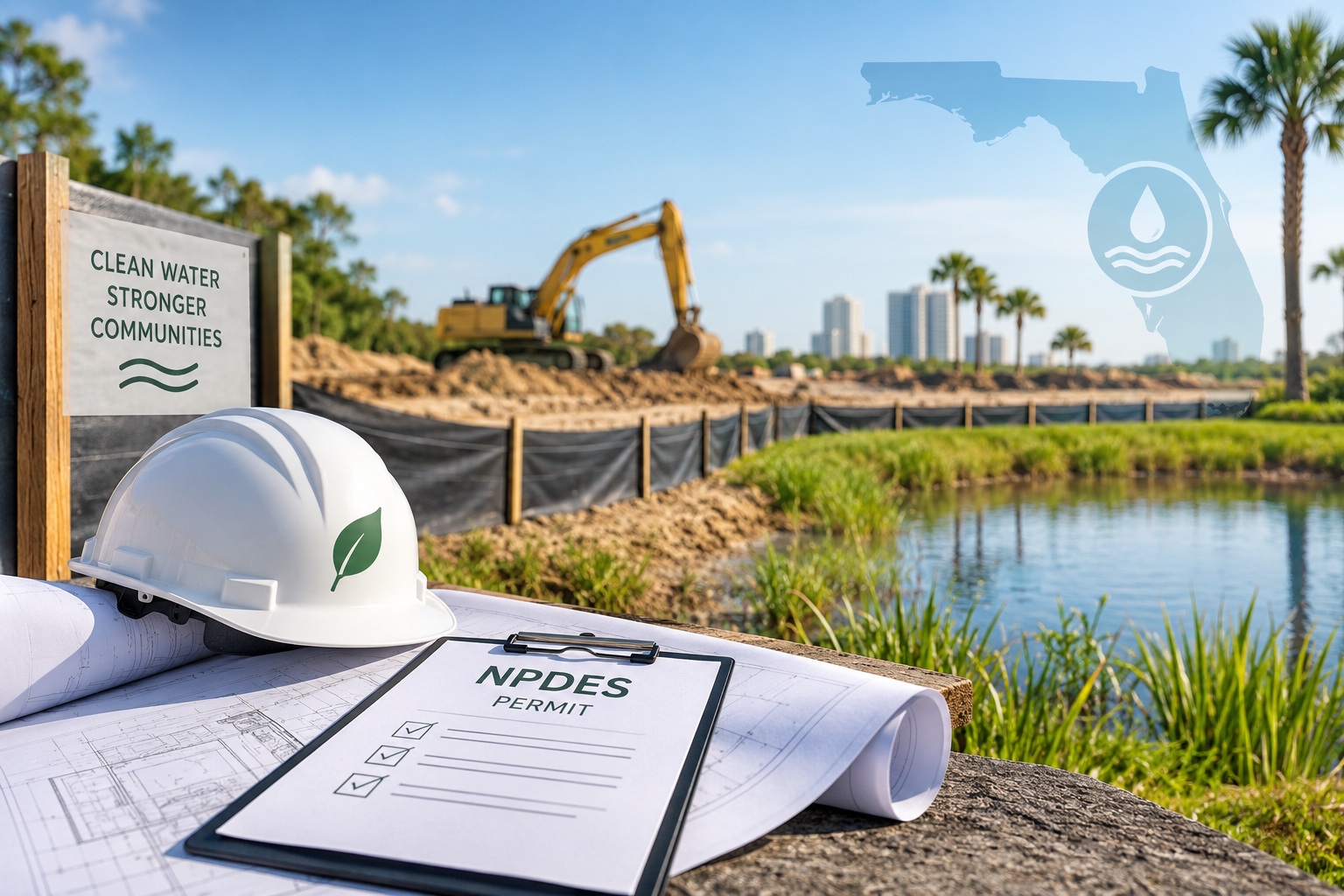
If your Florida construction project will disturb one acre or more of land, or is part of a larger common plan of development or sale that will disturb one acre or more, you likely need coverage under Florida’s NPDES Construction Generic Permit before land-disturbing activity begins.
This permit governs how stormwater runoff is managed during construction. Skipping it can create avoidable delays, enforcement exposure, failed inspections, neighbor complaints, and costly corrective work.
Here’s what contractors, developers, and property owners need to know before breaking ground. Understanding Florida’s NPDES permitting requirements before construction begins can help contractors avoid delays, maintain compliance, and keep projects on schedule.
What Is an NPDES Construction Permit in Florida?
The NPDES program is a federal Clean Water Act requirement, administered in Florida by the Florida Department of Environmental Protection (FDEP) rather than the EPA directly. It regulates stormwater discharges from construction sites to prevent sediment, chemicals, and debris from washing into nearby waterways, wetlands, and storm drains.
In Florida, most construction projects disturbing one or more acres, or that are part of a larger common plan of development or sale that adds up to an acre, must obtain coverage under the NPDES Construction Generic Permit (CGP) before land-disturbing activity begins. The CGP is a permit by rule: coverage generally takes effect once FDEP issues an acknowledgment letter in response to your Notice of Intent, not automatically on filing.
The obligation to obtain and maintain coverage attaches to the operator of the construction site (which may be the owner, the developer, the general contractor, or another party with operational control over the work). Contractors shouldn’t assume this is only the property owner’s responsibility. Liability follows whoever operates the site.
Who Needs an NPDES Construction Permit in Florida?
You will generally need coverage under an NPDES construction permit in Florida if your project involves:
- Clearing, grading, or excavation disturbing one acre or more
- Smaller sites that are part of a larger phased development or common plan of sale
- Projects where stormwater runoff may discharge to wetlands, ditches, storm drains, streams, or other waters, especially when the one-acre or common-plan threshold applies
Being near a wetland or waterbody doesn’t by itself trigger CGP coverage. The basic trigger is the disturbance threshold above. Proximity to wetlands does, however, increase both environmental risk and the odds of additional local or state permitting requirements, so it’s worth flagging early even on sub-acre sites.
Projects commonly requiring permit coverage include:
- Residential developments
- Commercial buildings
- Industrial facilities
- Road construction
- Infrastructure improvements
- Utility installation projects
Even projects just under the one-acre threshold can trigger permitting requirements if local jurisdictions have stricter rules, so it’s worth confirming before you assume you’re exempt.
Understanding the NPDES Permitting Process
Obtaining coverage under Florida’s NPDES Construction Generic Permit (CGP) involves several important steps before, during, and after construction.
1. Notice of Intent (NOI) & SWPPP Preparation (Pre-Construction)
Before construction begins, a site-specific Stormwater Pollution Prevention Plan (SWPPP) is prepared to identify potential sources of stormwater pollution and outline the Best Management Practices (BMPs) that will be used throughout the project.
The project operator, or their environmental consultant, then prepares and submits a Notice of Intent (NOI) to the Florida Department of Environmental Protection (FDEP) requesting coverage under the CGP.
2. FDEP Acknowledgment Letter (Before Land Disturbance)
Coverage under the CGP generally becomes effective once FDEP issues its acknowledgment letter. Contractors should plan for this step in their project schedule rather than assuming permit coverage begins immediately after submitting the NOI.
3. Routine BMP Inspections (Active Construction)
During construction, permitted sites must be inspected at the frequency required by the CGP and the project’s SWPPP. This typically includes routine inspections and inspections after qualifying rain events to verify that Best Management Practices (BMPs) are functioning properly and to document any corrective actions.
4. Notice of Termination (NOT) (Project Closeout)
Once construction is complete and the site has achieved final stabilization, the project operator submits a Notice of Termination (NOT) to close out permit coverage and complete the project’s stormwater compliance requirements.
Key NPDES Construction Documents
| Document | Purpose | When It’s Required |
| Notice of Intent (NOI) | Requests coverage under Florida’s Construction Generic Permit | Before construction begins |
| Stormwater Pollution Prevention Plan (SWPPP) | Identifies stormwater risks and outlines Best Management Practices (BMPs) | Prepared before construction and updated throughout the project |
| Inspection Records | Document routine inspections, rainfall events, and corrective actions | Throughout active construction |
| Notice of Termination (NOT) | Ends permit coverage after final stabilization | At project completion |
What Is a Stormwater Pollution Prevention Plan (SWPPP)?
A Stormwater Pollution Prevention Plan (SWPPP) is one of the most important documents required under an NPDES construction permit in Florida.
The SWPPP explains how stormwater pollution will be prevented throughout construction.
A typical SWPPP includes:
- Site maps
- Drainage patterns
- Erosion and sediment control measures
- Inspection procedures
- Maintenance schedules
- Spill prevention procedures
- Pollution prevention practices
The SWPPP is a living document and should be updated whenever construction activities or site conditions change.
Why Is a SWPPP Important?
A Stormwater Pollution Prevention Plan also serves as the project’s roadmap for managing stormwater throughout construction. A well-prepared SWPPP helps contractors identify potential pollution risks, implement appropriate erosion and sediment controls, document inspection procedures, and demonstrate compliance during regulatory inspections. Keeping the plan accurate and up to date also helps reduce the risk of violations, project delays, and costly corrective actions.
Common NPDES Compliance Mistakes
Many construction delays occur because stormwater compliance is treated as an afterthought. Avoid these common mistakes:
- Waiting too long to start the permitting process. NOI review and SWPPP preparation take time, and coverage isn’t effective until FDEP’s acknowledgment is issued. Starting the week you want to break ground almost always causes delays.
- Treating the SWPPP as a one-time document. FDEP expects it to be updated as site conditions change, not filed and forgotten.
- Missing inspection documentation. Verbal confirmation that BMPs are “fine” isn’t enough. Inspectors need dated, written records at the frequency your CGP coverage and SWPPP require.
- Overlooking whether Spill Prevention, Control, and Countermeasure (SPCC) requirements may apply where fuel or oil storage is present. SPCC applicability depends on oil storage capacity and discharge potential, not simply the presence of a tank. It’s worth confirming rather than assuming either way.
Assuming the property owner alone is responsible. The operator (which can be the contractor or developer) holds the compliance obligation, so responsibility should be spelled out clearly in project agreements.
Why This Matters Beyond the Fine?
Beyond the risk of enforcement action, unmanaged stormwater runoff is one of the most common causes of neighbor complaints, muddy discharge into adjacent wetlands, and delays from local code enforcement, all of which cost more in schedule slippage than the permitting process itself.
How IVA Environmental Can Help?
At IVA Environmental, we help contractors, developers, and property owners navigate the NPDES construction permitting process from start to finish. Our experienced team prepares Notices of Intent (NOIs) and Stormwater Pollution Prevention Plans (SWPPPs), ensuring your project has the documentation needed before construction begins.
We also track FDEP acknowledgment so you know exactly when permit coverage takes effect, conduct scheduled stormwater inspections throughout construction, and help maintain compliance with permit requirements. Where applicable, we evaluate whether Spill Prevention, Control, and Countermeasure (SPCC) requirements apply to your site.
Once construction is complete, we prepare and file the Notice of Termination (NOT) to properly close out permit coverage. With end-to-end environmental compliance support, IVA Environmental helps keep your paperwork, permitting, and construction schedule working together, not against each other.
Conclusion
Stormwater permitting is easiest to manage when it’s built into a project’s planning, not treated as something to figure out once construction is ready to begin. From determining whether permit coverage is required to preparing a SWPPP and maintaining inspection records, each step plays a role in keeping work moving without unnecessary interruptions.
Taking the time to understand those requirements early gives contractors and developers a clearer path forward. IVA Environmental helps project teams figure each stage of the NPDES permitting process with practical guidance tailored to their site’s needs.
Frequently Asked Questions
When is an NPDES construction permit required in Florida?
Most projects disturbing one acre or more of land—or part of a larger common development exceeding one acre—require permit coverage before construction begins.
What is a SWPPP?
A Stormwater Pollution Prevention Plan (SWPPP) outlines the erosion control, sediment management, inspection procedures, and pollution prevention measures used throughout construction.
Who is responsible for obtaining the permit?
The project operator is responsible for obtaining and maintaining permit coverage. Depending on the project, this may be the owner, developer, or contractor.
Can construction begin before permit approval?
No. Construction activities that disturb soil should begin only after FDEP acknowledges permit coverage.
How can IVA Environmental help?
IVA Environmental assists with SWPPP preparation, NOI submissions, stormwater inspections, compliance monitoring, and project closeout documentation to help contractors meet Florida’s NPDES requirements.
Do I need an NPDES permit if my project disturbs less than one acre?
Not always. Projects disturbing less than one acre may still require permit coverage if they are part of a larger common plan of development or sale that will disturb one acre or more. Local permitting requirements may also apply depending on the project’s location.
What happens if construction begins before NPDES permit coverage is effective?
Starting construction without the required permit coverage may result in regulatory enforcement, project delays, and corrective actions. Because permit coverage generally becomes effective only after FDEP issues an acknowledgment letter, contractors should confirm coverage before beginning land-disturbing activities.
